| Other ... |
Various tests, examples, cases or movie files, which do not fit into the other galleries ...
Ricoh GX100 shutter accuracy tests
![]() |
Ricoh
GX100 shutter
accuracy
tests (18 November 2009) After 2 years of using my first Ricoh GX100 and about 200,000 shots taken with it (most of them in the interval mode), I decided to purchase a second GX100, as a backup to the first one. This was a good opportunity to test the accuracy of the shutter mechanism of the first heavily used camera, comparing it to the new one. The test was simple - shooting simultaneous interval sequences, with both cameras set identically in the manual exposure mode (M), WB set to "cloudy", and AF set to "infinity". My expectation was that the older camera is going to show somewhat more flicker, namely at shorter exposures - due to irregularity of the exposure which I was expecting as a result of the "mechanical wear" of the shutter. All the movies below are 5 minute sequences, taken at 5
second intervals; all of them are resized (to 640x480) only from the full
image size (F quality), and saved without any other processing as H.264 MOV
files at their best possible quality, to avoid any artificial flicker
resulting from the movie compression. The frame rate is 10 fps, which is
about optimal to show the flicker of the individual frames. All of these
files are about 4 to 4.5 MB large:
Both cameras do not show any flicker at the longer exposures (1/320 and 1/640), from 1/800 to 1/1250 they show about the same level of light flicker, and at 1/2000 the new GX100 shows even more flicker than the old one. This result is rather surprising: I was expecting the older camera to show more flicker, namely at the shorter exposures. Added later: it was explained to me that in digital cameras there is no classic mechanical shutter like in the film cameras. The exposure time is set electronically, and the mechanical "shutter" closes the lens system during the readout of the CCD only. Thus, the only part in GX100 related to exposure which is set mechanically is the diaphragm. Therefore the flicker at the shortest exposures is probably related to certain inaccuracy of the exposure period, and has nothing to do with mechanical wear of the "shutter" system... |
![]() |
30 August 2008,
Prague, Ricoh GX100
HD 720,
HD 1080
20080830_1280x720.mp4
(H.264, 11.8 MB) I was just curious to see what will the Ricoh GX100 timelapse movies look like in HDTV format, 1280x720 and 1920x1080 resolution, so here is the result, several examples. To play smoothly namely the larger size movies you will need more powerful computer, and to see all the fine details in their best quality you will need a 1920x1080 display. All the movies here are at 30 fps; the .mp4 and .avi are at 4500 kbps, and the .mov file was saved at 75% quality. The movies were prepared from the full resolution GX100 JPEG images, processed in Photoshop. You can compare these movies with those which are at my standard resolution, 1024 pixels wide, in the 2008 gallery. |
My very first time-lapse movies ...
![]() |
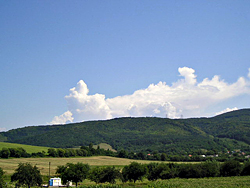
2003
- 08 - 01 10:52 - 12:15 UTC (1h 23m), manual
capture Olympus C350Z, interval 5 seconds, speed 150x 20030801_1052-1215utc_Lubina.mpg
(17.8 MB, 640x480, MPEG1) Captured manually, pressing the shutter-release button every 5 seconds, for 83 minutes, almost 1000 images... The quality is very poor (by my today's standards) for several reasons: besides the manual capture (resulting in tiny jumps of the framing), the camera was set to fully automatic mode, thus trying to focus, measure the exposure and set the white balance for every single frame. The movie shows the original pictures, as captured by the camera, without any further post-processing. Taken from Lubina, district Nové Mesto nad Váhom, western Slovakia. |
![]() |
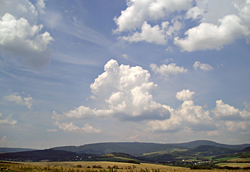
2003
- 08 - 02 11:42 - 12:11 UTC (0h 29m), manual
capture Olympus C350Z, interval 5 seconds, speed 150x 20030802_1142-1211utc_Javorina.mpg
(3.8 MB, 1024x704, MPEG1) After several more experiments carried out after the case above, this time-lapse movie is already much better. The improvement resulted from switching the camera to "Landscape" mode, avoiding thus the focus and white balance problems. Taken from above Lubina, district Nové Mesto nad Váhom, western Slovakia; view towards Velká Javorina at the Czech-Slovak borders. |